Deodorants that are commercially made can have a lot of chemicals that might not necessarily be desirable. Either way, I am often on the lookout for simple, healthful and natural ways to do things.
Here is my recipe for a simple home-made deodorant that has been working well for me.
All we need to make the home-made deodorant is as follows:
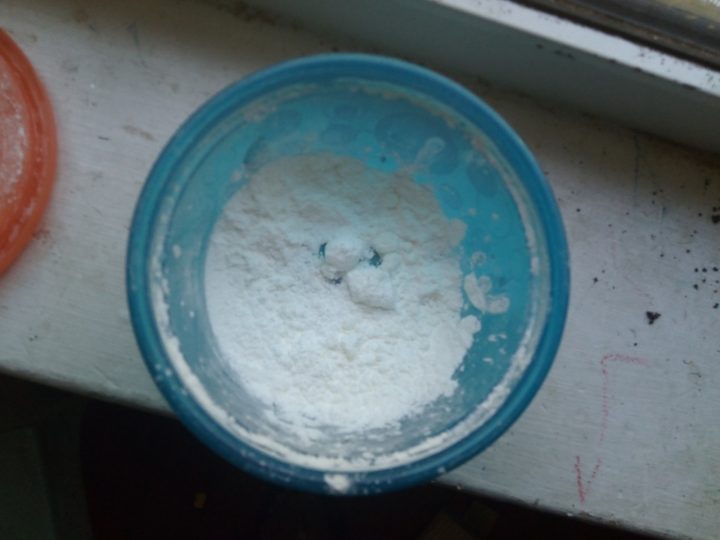
Take a bowl with a lid
Add some corn starch powder
Add an equal amount of baking soda
Add 2-3 few drops of an essential oil. I use the ‘stress free blend’. Here is a link for the product on Amazon: https://www.amazon.com/Healing-Solutions-Stress-Therapeutic-Essential/dp/B00QXVNRGY
Close the lid to the bowl with all the above ingredient.
Shake the above mixture
Add a powder puff to use as an applicator.
You are all set!
Baking soda can cause a little burn or irritation if applied on wet skin. So try to dry your skin well before applying the deodorant.
I was unprepared for the numerous surprising topics I would be excited and exasperated by being part of a unique intercontinental marriage: a Tamil Iyer from South India married to an Irish American. Some of these hot topics have included: whether there are buffalos in India, the size of Hollywood versus Bollywood and innumerable minor and major cultural differences. We didn’t realize we had so many differences before marriage and we even naively assumed we spoke the same English!
Despite watching so many movies from both the East and the West, we were not prepared for the transport differences between India and America. I currently obsess over the car seat for our 2 year old and traffic safety: repeatedly reminding my husband, to ‘slow down’, ‘watch for that car’, ‘wait for the green arrow to turn left’ on the highways of the United States. He was not amused when I was sitting back relaxed in an auto expertly navigating the streets of Hyderabad, as he sat on the edge of his seat. Funnily enough, he attempted to wear the seat belt in the car on our trip from Rameswaram to Kanyakumari and the car driver turned around and told my husband with a nod and a wave of his hand, “Seat belt not required, don’t worry!”
On the village roads of Kerala, the town buses zoomed past, driving fast and our car narrowly avoided many cycles, buses and people. I kept chatting away calmly, not even flinching, not realizing the adrenaline-pumping scary ride experience that my husband was having! This is in stark contrast to his calmness on big US highways and my panic attacks on the unidirectional American roads.
I remember finding the closest gas station to pull over after panicking on my drive into Atlanta as the highway exit turned into a multi-lane road: the lights of the tall buildings amplified the dizzying effect and increased my anxiety. On another occasion, I was stuck on the so-called flat top mountain in Asheville after following the GPS incorrectly. I can still picture the steep slopes of the hill, on a dark night and hearing a random waterfall nearby: a scary enough an experience to become permanent part of my adventure travels. I definitely did not make it to the flat top on that slope, and miraculously managed to turn around to drive down the hill. It is no surprise I don’t dare drive to Asheville alone again!
Before having a GPS, I had frantically called my husband, miles away from the house at 9pm, telling him not only that I was lost, but asking him, “Where am I?” It is amazing how one can be confident with what one is familiar with. As I chatted away with the auto-driver in India, my American husband experienced a roller-coaster ride. It is the opposite with the highways in the US for me. Point to note though, that in our three weeks in India, we encountered not one road accident; but usually encounter at least a couple a week on the way to work during rush hour here in the US. Needless to say, our travel travails don’t end with cars and traffic either.
With great excitement, I had boarded my first train from Columbia, South Carolina. I could not wait to experience a train ride, American style. I guess I expected there would be several stops for coffee and snacks. Did I really expect vendors yelling “idli-sambar, mendhu-vada?” Consciously not, but I imagined something similar in the western style. Despite the repeated visits to the train kitchen, the long ride with little vegetarian food to eat, and not being able to lie down for the long journey left me exhausted and longing for Indian train rides again. On our India trip, I could not wait for our first train ride together. However, the experience humbled my self-view as the Indian train expert. I somehow mistook the numbering of the coaches and confidently had us get on the opposite end of the train to reach our berth at the other end. If anyone knows what it is like, to walk through a crowded train in motion, from one end to the other, holding two suitcases, it is a feat no less intense than a major workout at the gym! This is when my American husband had to fully become a Tollywood hero to lug this heavy load to our berth in the AC car!
With all the complaints of having to drive on scary highways or wistful reminders of the wonderful Indian train journeys, I remind myself of the irony of it all. Growing up wishing to have my own gaadi to go anywhere anytime without waiting for buses, I find it ironical to complain about having to drive. While Shah Rukh seemed quite content singing ‘Ye Dil, Dil, Deewaana’ in the movie ‘Pardes’, I never imagined panicking to drive across the beautiful Ravenell bridge in Charleston, SC.
I remember a time early in my driving days when I called my husband frantic that the gas station credit card machine was unable to read my card. I was out of gas. He had to wake up early on a Saturday morning to find me stranded at a gas station. Once he paid with his card, I took out a 20 dollar bill and asked him if we need to buy milk! I had not known that one could pay for gas using cash. Of course, it can only be a guess how my request for some petrol for the car would have gone. At times, our experiences have definitely been a case of ‘I Love Lucy’, desi style!
Amidst the irony of finding myself complaining about things I had wanted and comparing with what I used to have, I am reminded about one Indian phrase :’’Chalta Hain’’. Maybe I could ‘Take it easy Urvashi’ like Prabhu Deva dancing atop buses, when someone cuts me off on the road or an aggressive truck is tail-gating my car. ‘Taking it easy’ and an unconditional acceptance of everything just as it is, something I learned growing up in India, can assist me in navigating life in the Carolina lanes.
Maybe a recording of the Indian traffic sounds and the orchestra of ‘beep beeps’, would finally let me relax when my husband is driving the car. The fact is that safe car practices are important anywhere, and although travels and transport systems may vary, an accepting attitude has a place wherever one is on the journey of life. So, let’s take the time to enjoy what we have: all the beeps, autos, cars, trains and traffic travails in slow lanes or fast.
The pursuit of healthful and natural ways to diaper my child, led me to the idea of exploring similar options for myself during menstrual cycles. Afterall, disposable menstrual pads can also contain various chemicals and accumulate in landfills.
After some researching and trial and error, I found some cloth pads on Amazon and a system to wash and maintain them in a way that is easy and fairly feasible for me even with a toddler and a job.
My most favorite cloth pads for a regular day of bleeding is from the company ‘Heartfelt‘.
I found that charcoal pads can feel too warm or itchy and uncomfortable if the bleeding is not high, like on the first day or spotting etc. Charcoal pads seem the most comfortable on days where is medium to heavy bleeding.
For overnight and heavy bleeding days, I use an extra long charcoal pad from the company ‘HiBaby’ and also Heartfelt.
Once again, these charcoal pads are very comfortable and best-suited for days of heavy flow and overnight use. I still change these pads atleast once overnight.
With any menstrual pad, the key is to change the pad when it starts to feel wet. With charcoal pads, it is harder to see the wetness because of the color of the charcoal. I have found charcoal pads to be wonderfully absorbent. So at the first sign of wetness, I assume that the pad is sufficiently soaked and change them.
For the days of lower bleeding, I use the pads from the company ‘Love My Antibacterial Bamboo‘ pads. These pads are very soft and comfortable. However, they don’t seem to absorb too much fluid. These are best suited for the last few days of a period where this is a much lighter flow. On such days, a charcoal pad could feel itchy and dry. These pads feel very comfortable on those days.
I recently also discovered some soft liners that can be used for the last few days of spotting after a period. I found them also on Amazon, here.
These pads from the company Heartfelt, also have some good liners for the last few days of light flow.
Despite using the pads, sometimes, one needs an additional layer of protection to prevent leaks. One of the ways to prevent leakages is to wear period-panties. The ones I have used and have worked for me very well are from the company: Yoyi
One can also find some additional buttons to use to secure the pads to the unedrwear. I found some good ones at ‘Party in my pants’
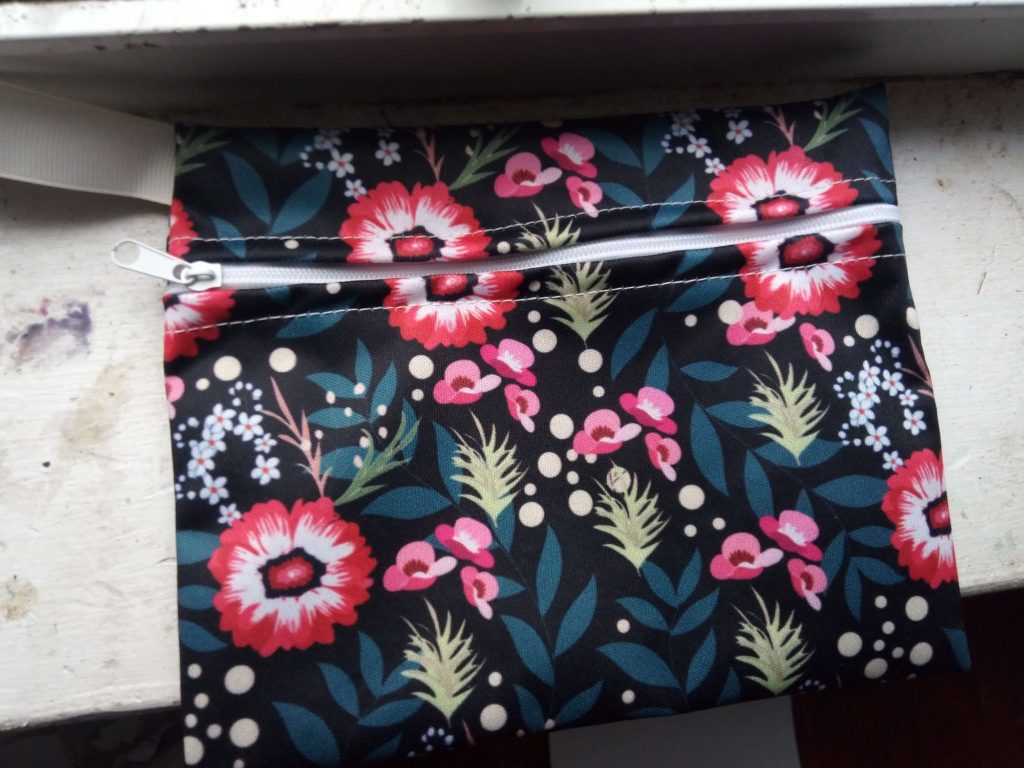
While outside the house, I can just fold and place a used cloth pad in a colorful and waterproof carrying pouch
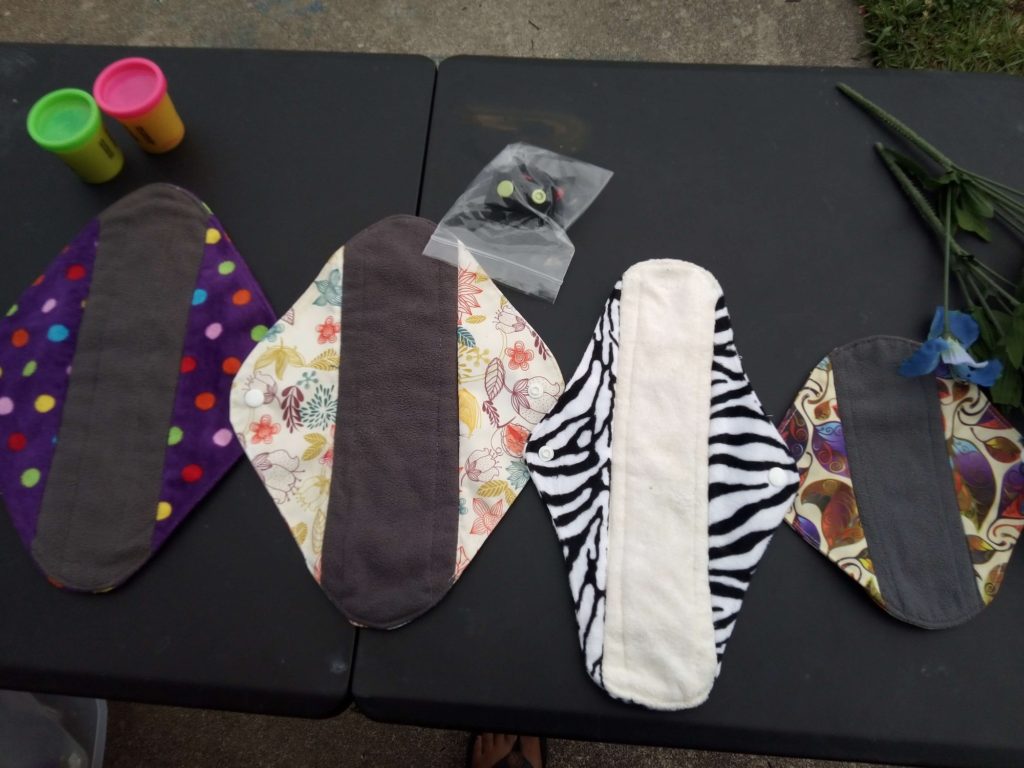
My assortment of pads: from the ones for heaviest flow to the left to the ones for lightest flow to the right.
Maintenance of cloth pads:
The main advantage in my opinion, of using disposable pads is the ease and convenience of just dropping a used pad and getting a fresh new one…With a simple system, I have been able to get a similar convenience with my cloth pads.
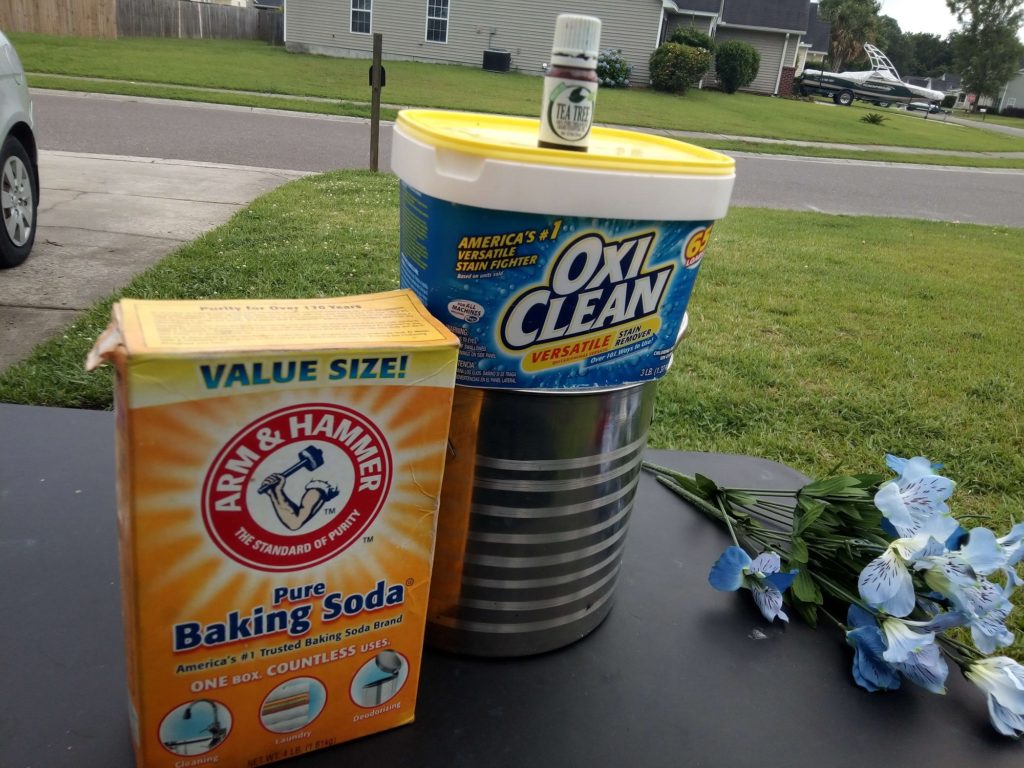
I have two stainless steel containers (bought for a few bucks at a local store), in which I add warm water, oxyclean, baking soda and a few drops of Tea Tree Oil. I just put my used pads in this mixture to soak. Usually, I soak the heavily absorbant pads in one container and a lightly soiled pad in another container, with a similar mixture. It is important to change the water every 8 hours atleast. The menstrual blood comes out of the pads into the water and so it must be carefully poured out into the toilet using gloves. By the time one has changed the water/oxyclean mixture 2-3 times, most of the menstrual blood comes out of the pads. Then one can just wash the pads with some bar detergent. I use RIN bar detergent to gently wash the pads. Any clothes detergent should workf or this purpose.
My cleaning mix: Baking Soda, Oxyclean and Tea Tree Oil to mix with warm water in the stainless steel container to soak the pads in.
I don’t put any of my menstrual pads in the laundry because I consider that to be very unhygienic. Laundry machines have a tendency to accumulate germs and I would not want to put my menstrual pads in the same machine where the rest of my family’s laundry also goes in.
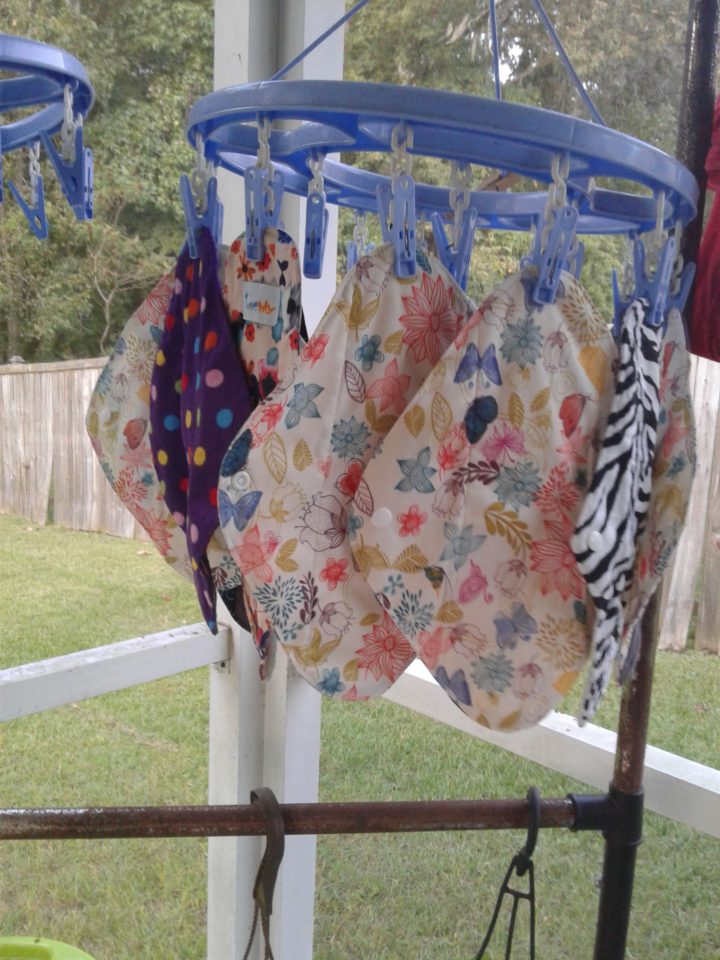
Once I wash the pads, I just hang them out to dry. Any regular clothes-handing line could work. I try not to expose the pads to direct sun, but do let them dry outside for a few days.
I resoak all my washed pads into the steel container, but now with just some water and vinegar. This makes the pads get an additional level of disinfection as well as making them soft for the next use. I soak the pads overnight and just rinse them out with water and dry them again, before finally putting my nice, clean, dry pads in my pads container in the bathroom for their next use.
Sometimes, I don’t have enough space in my steel container to soak all the pads. During that time, I store my pads in a small trash can, meant specifically for my pads (no trash goes in it!). I use a waterproof liner in the can.
I also soak my period panties in the steel containers with the water/oxyclean/baking soda/Tea tree Oil mixture. After perhaps one change of water, all the stains of blood come out and I just use a bar detergent too handwash the period panty and dry them outside.
Once the panties have been washed and dried, I may occasionally put them in the laundry with my regular wash, since the only get a few stains and don’t soak a lot of blood.
One important contraption I use to keep my pads in place in my panties is : Fabric Velcro This is really an inexpensive but very useful product that keeps my pads in place and prevent leakages.
It might seem like a lot of financial investment to set up the cloth pads. However, I have not wanted to go back to purchasing any disposable pads since the December of 2017. The investment of my pads, cheap stainless steel containers to soak them in, baking soda, oxyclean and other materials has given me many rewards.
I am not sure if it is a psychological effect or a physiological effect. But it sure does feel like my periods are a lot of comfortable and even sometimes pleasant due to the cloth pads.
After discovering cloth menstrual pads, I feel like I have found a better alternative to disposable pads for my monthly cycles.
I hope you find this article useful and if you do, please send in your comments and suggestions.
My colorful carrying pouch to store used and unused pads when out and about.
Much as it might seem, like everything is normal in one’s own little world and backyard, there is reason to heed to all the warnings to stay at home. I can relate well to concerns of a parent, trying to keep a child active and entertained during the quarantine. I have a very out-doorsy and social 3 year old who is used to going to story-time several times a week and parks and other outings at least twice a day.
It is especially hard, on a perfect warm and sunny day, to NOT go outside and play!
It looks like the neighbors are having a get-together and other kids are out on their bicycles and nobody seems to be sick in the near neighborhood.
So, what could be so bad about going out for a little play? If this is how a parent is thinking today, it is completely understandable. However, I want to share why it is very important, to try to see beneath the obvious and be aware of the hidden dangers of the COVID-19 pandemic.
First of all, let me clear the myth, that this is just like a flu. The flu can be quite dangerous. However, it does not spread quickly into a worldwide pandemic! It is not that the media has created a panic-based pandemic around the world.
The facts are that the COVID-19 coronavirus, a virus similar, yet not quite the same, as just another common cold virus, is a relatively new, dangerous and highly infectious one.
In my opinion, the reason the virus has spread so fast around the world, is because, unlike the flu, where one can feel sick soon after getting infected, with the COVID-19, one may go with no symptoms at all for about 2 weeks. During this time, one can still be highly infectious. Imagine someone with a flu and fever. They are likely to take time off work, stay home to rest and not go out shopping or working out at the gym.
This way, they limit their ability to infect others significantly. With the COVID-19, one can feel ‘normal’ and asymptomatic for up to 2 weeks, whilst going out to work, meeting people and infecting others along the way.
So, why would I not want to take my toddler to the harmless playground nearby? Because it is not guaranteed that me or anyone in my family has not been exposed to the virus. We could be spreading the virus in the playground and play equipment. It is also possible that someone else spreads the virus on the play equipment and we would be bringing it home.
With the flu, at least one can get Tamiflu or be vaccinated ahead of time. With the COVID-19, no clear treatment is apparent. A whole lot seems to depend on individual health and immunity levels.
Perhaps my family will be healthy enough and strong to fight it off. Perhaps another person who visits the playground could get seriously sick or worse. Would I want to risk doing that to someone? And what if it does that to me or someone in my family?
This may seem like a very straightforward, simple and logical reason to NOT go out during the quarantine.
But seeing the number of kids running around and the number of hangouts and get-togethers happening in my neighborhood, I guess this simple reasoning and fear is not sticking with families.
When we can’t see the fire or smell the smoke, why would someone panic? COVID-19 is like a fire that cannot be caught by the smoke alarms until it is too late.
If one could just be safer than sorry, why wouldn’t one do that?
One more thing to note is that the virus is not entirely a living entity. It can only live in a host. Thus, we can break its chain of transmission, we could be saving a lot of people and even whole communities.
How many times do we can the opportunity to save the world by relaxing indoors on the couch?
So the next time my toddler tries to drag me out to a playground, I will remember my role as not just a parent who wants to keep my 3 year old as happy as he can be, but also a citizen of the world and a parent whose duty is to keep my child, my family and society safe.
Maybe I can find a way to play dress up and build castles with cardboard boxes in the backyard instead!
Stay home, stay safe and let the pandemic blow off in a haste!
The opinions expressed in this article are solely of the author and not guided by any medical agency. For the most accurate guidelines, contant your medical providers.
The lesson above is based on the author’s dialect growing up in South India. There are many different dialects and usages of the language and the auhor claims no responsibility for perfect accuracy of the content or matching any/all dialects of the language.