I am often asked the question ” so how do arranged marriages work”?
I don’t always know what exactly the question is meant to imply. Is the question about how marriages work?
How would a marriage in the western world work? Why would it be a thing to ask how does an arranged marriage work? It often makes me want to answer-”just like all marriages work. One has to work at it”.
Plus some luck is involved. And love, of course.
But I understand, that sometimes, the real meaning of that question is based on an assumption that arranged marriages are ‘forced’ or decided unilaterally by the parents etc. The question”how do arranged marriages” work, typically express some judgement about a practice that seems antithesis to their idea of ‘freedom’. It also expresses some level of confusion or ignorance about what an arranged marriage really is.
In order to explain that, I would discuss someone trying to buy a house. Doesn’t the person research the neighborhood, the schools in the area, the potential neighbors, commute to work etc? Wouldn’t one research online, ask friend or family about it and get some opinions before making their decision?
How about career choices? There are often guidance counselors who would give out suggestions based on a student’s past academic performance, aptitude and interests. High school courses are often decided based on consultations with guidance counselors and parents.
So, when it comes to making a serious decision of marriage, where one chooses a life partner, it seems only logical to ask one’s parent and others close to us, for advice on the topic.
In a typical scenario for an arranged marriage, a marriage broker collects information about a potential bride or a groom. He/she also collects pictures of the girl or boy. Then a couple of suitable matches are found, based on the interests and backgrounds, as described in the ‘marriage biodata’. Often, the desired qualities in a partner are also included in the ‘biodata’ and used for the matching. This is very similar to online dating. Only, this practice existed before the internet era. The marriage broker, brings the photos and biodatas of potential matches to the boy/girl’s family. The family of the potential bride/groom goes through the photos and biodata and screens these for a smaller pool. Meetings are arranged with some of these prospective alliances, where the whole family comes to visit. Usually, the potential groom’s family visits the house of the potential bride.
The girl and boy are often allowed to sit somewhere separately, like on a terrace and talk privately. This would be comparable to a ‘date’, except that the family and parents are often in another room nearby!
Nowadays, the matching is done online through portals such as ‘Shaadi.com’ and other online matchmaking sites.
Once, again, these are similar to dating apps, with the difference that the general primary purpose of these sites is to find someone to marry rather than just date.
A lot of the ‘meetings’ with the potential alliances don’t always pan out. Once the families and the boy and girl meet, they take their time to respond with their decision. Often times, the girl may reject the boy or the boy may reject the girl. The meeting of the families, ensures that there would be parental and family support for the couple in the future, if they choose to go forward with the alliance.
Generally, the final decision is usually that of the boy or the girl. It may even take upto 2 years to actually find a match that works out. So, this is similar to online dating. The difference is that the families do an extensive background check on the family and neighborhood of the potential life-partner for their son/daughter. This ensures that at least there would be some element of security about the family and personal background of the potential bride/groom.
Also, this creates a sense of accountability at the ends of the families involved. If the boy turns out to be mean to the future wife, the parents of the girl can ask for accountability with the parents of the boy, who may in turn, intervene to help the girl out, should such a situation arise.
The potential couple also generally receives assistance with childcare when a baby is born.
Forced marriages are another matter. Arranged marriages involve the consent of the boy and girl involved which may not be the case with a forced marriage.
All this comes down to the relationship between the boy/girl and his/her parents. If there is good, clear and healthy communication between the parents and the child, the feelings wants and interests of the child will be paramount in this process. It is helpful to have some guidance and advise from one’s parents, who generally know their son/daughter and look out for their well-being.
When it doesn’t work well, is when there is not good communication between the parents and their children. A lot of love-marriages may not work due to lack of family support. Some do not work because there was not enough background check done on a person with whom one may ‘fall in love’.
Anyone who has tried to find a partner by going through the ‘dating world’ may understand, that is is not easy to find someone compatible or ‘fall in love’ with the right guy/girl. There are mistakes, heartbreaks and wrong choices involved. Some people are lucky and find their mate at the first try. Luck has a big role to play in finding the right partner, be it through dating or arranged marriages.
In the western world, one tries to figure out the true nature of a potential partner by dating them and getting to know them over time. Some live-in, for what could even be years, before they make their decision to marry. There could be a lot of vulnerability involved. Or the potential partners do not get too vulnerable until they have gained trust in the other person over the years. If kids are involved in this process, that could cause complications.
With an arranged marriage, there is a commitment to trust the process and trust that the person chosen is the right guy and commit to the marriage. The commitment and vulnerability is akin to stepping in with both feet in the water. This may create a dedication to make the marriage work. Perhaps that could explain why arranged marriages are generally quite successful. However, there is no judgement against someone who may want to test the waters before slowly committing for a life-time. Trust is something that is integral to a healthy marriage and sometimes, it may just take more time.
Sometimes people state that mine is not an arranged marriage. My husband and I don’t totally agree. We met through some synchronous events and incredible co-incidences that make us believe that this marriage was arranged by the divine.
All in all, I believe, that marriages are made in heaven and strengthened by commitment fueled by love.
I hope this article answers a few questions about arranged marriages and the way in which alliances are fixed.
How arranged marriages actually work? Well, I think that is still based on the dedication, commitment, communication and love between the partners.
Namasthe!
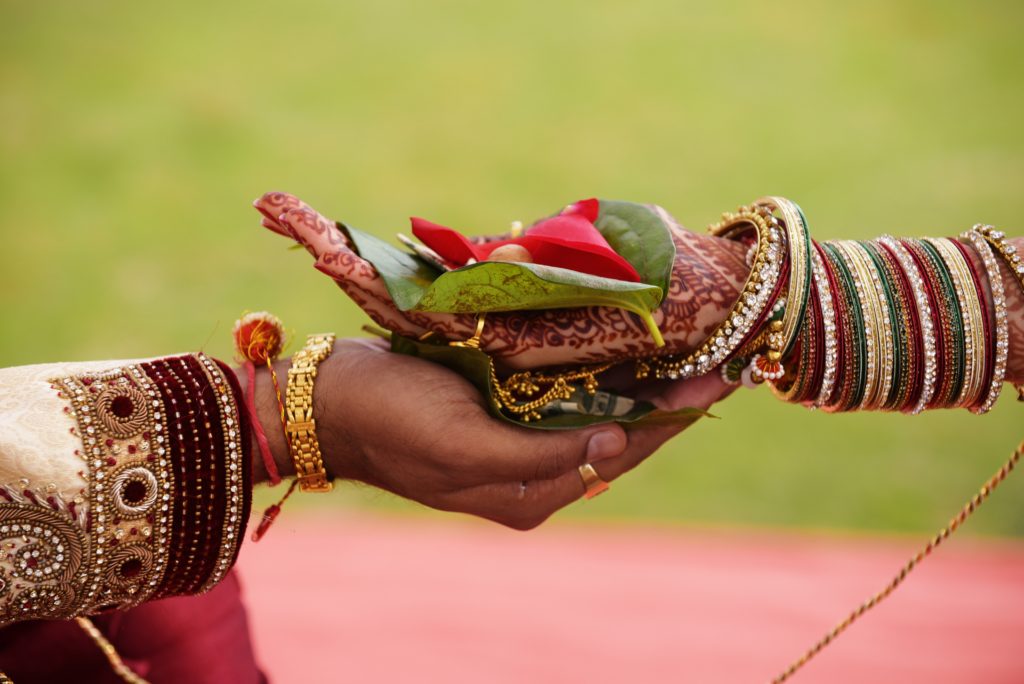
Photo credits:
Photo by AMISH THAKKAR on Unsplash
Disclaimer: these are only my personal opinions and are just aimed towards sharing. No offence or hurt feelings are intended.